
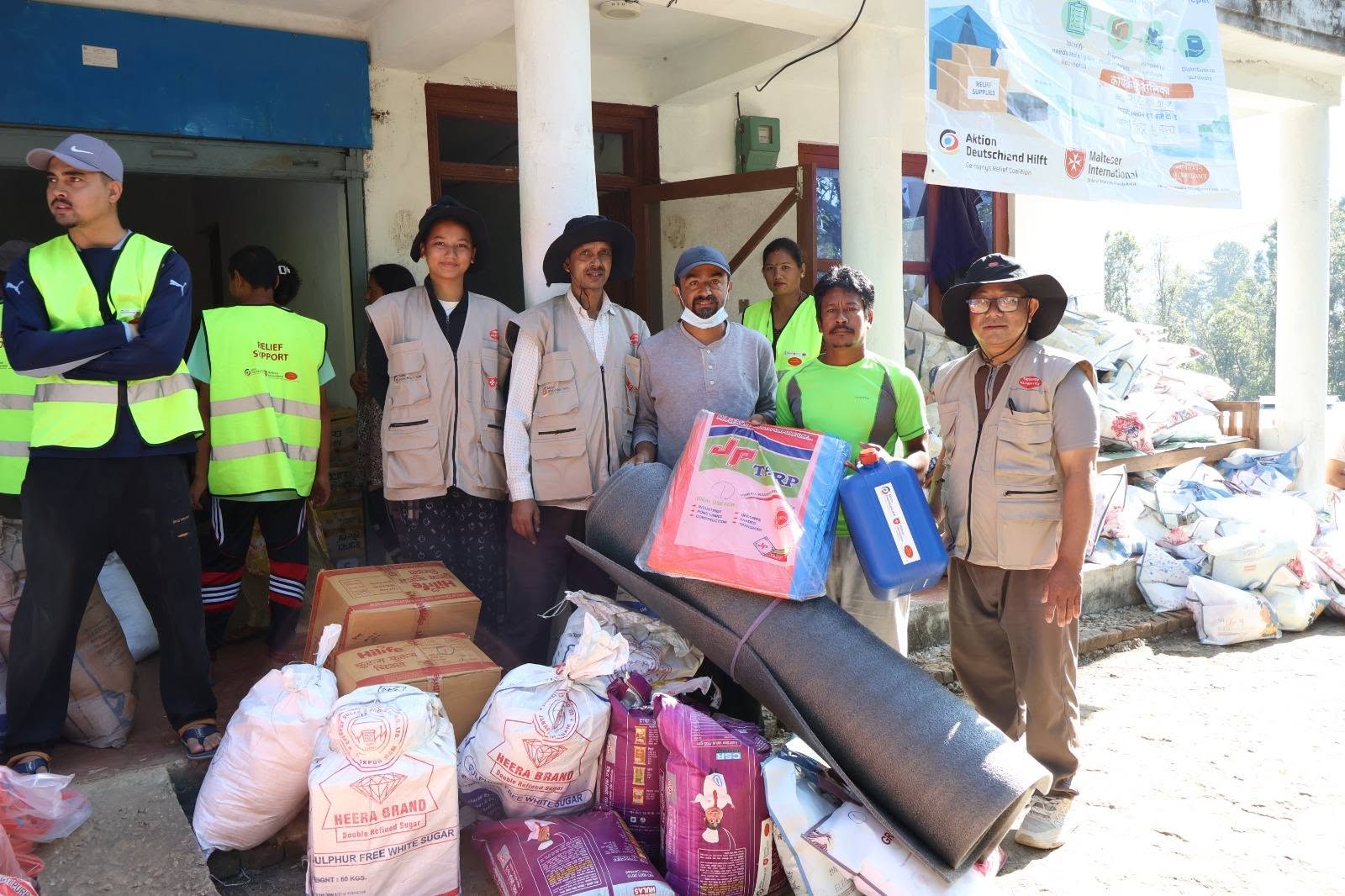
11th of Kartik, 2083, Wednesday, Uttar Gaya Rural Municipality, Rasuwa - The Rural Self-reliance Development Centre (RSDC), in collaboration with Malteser International (MI), has provided relief support to 405 flood affected households in Nuwakot and Rasuwa districts as part of the project “Emergency Assistance to Support the Flood Response in Nuwakot and Rasuwa, Nepal”. As a relief support, RSDC has provided 3 months’ worth of food supplies, cooking utensils, temporary shelter items and hygiene kits to 238 flood affected families of Bidur Municipality Ward 7, Nuwakot and 167 families of Uttar Gaya Rural Municipality Ward 5, Rasuwa.
Since many flood-affected families were displaced from their homes in the aforementioned areas, and had been taking refuge in their extended families’ homes in Kathmandu, the local Ward offices and Municipal bodies had requested RSDC to provide the support to those families in Kathmandu itself. As such, on the 9th, 10th and 23rd of Ashwin, RSDC had provided the relief support to 111 flood affected families of Bidur Municipality Ward 7 and 127 flood affected families of Uttar Gaya Rural Municipality Ward 5 in Kathmandu.
Likewise, RSDC has also provided support to the impacted families continuing to live in the flood affected regions as well. In the presence of local body representatives, RSDC has provided support to 127 flood affected families in Soley and Akkare areas of Bidur Municipality Ward 7 on 28th and 29th of Ashwin; and to 41 flood affected families of Uttar Gaya Rural Municipality Ward 5 on 11th of Kartik. Based on the lists of flood affected families as prepared by the respective local governments, RSDC had deployed its staff to collect additional information from the identified families and provided relief to them.
According to a study conducted by researchers from Chinese Academy of Sciences, a massive section of rock and ice had broken off simultaneously on 10th of Bhadra, from the northern slope of Langtang Lirung mountain from an altitude of approximately 5200m. As the mass of rock and ice continued to plunge downhill, reaching an altitude of 4010m within 30 seconds, a large section of the glacier was hanging down from above in a frozen state. In common terms this is referred to as the glacier snout. The mass of ice and rock that had suddenly broken off crashed into the glacier snout, breaking it apart and carrying it along with the flow. This accumulated debris of rock, ice and glacier then merged to form a massive avalanche, which began surging downhill at tremendous speed. Within approximately 100 seconds, an estimated 6 crore 70 lakh cubic meters of rock, ice and snow debris plunged into the Sochen river. Simultaneously, another 3 crore 60 lakh cubic meters of debris continued moving at high speed and surged into the Lhende river. This resultant powerful flow crossed the Nepal-China border, causing massive damage in the areas towards the Kerung customs, and thereafter into Nepal.
According to the preliminary assessment report shared by the National Disaster Risk Reduction and Management Authority (NDRRMA), the floods of Bhadra 10, affected a total of 7570 houses, 8317 families and 32,163 people. The floods claimed the lives of 1,457 people while other 5,285 remain missing.
At the onset of the disaster, RSDC had extended its support through the Prime Minister’s Disaster Relief Fund. Thereafter, in collaboration with MI, RSDC developed the project entitled “Emergency Assistance to Support the Flood Response in Nuwakot and Rasuwa, Nepal”. Upon acquiring approvals from the Social Welfare Council (SWC), and in coordination with the local governments, the project provided relief assistance to 405 flood-affected families in Nuwakot and Rasuwa districts.
RSDC expresses it sincere gratitude and appreciation to the local governments for their support and coordination in the relief efforts, and to the funding partner MI for its generous support in the project.